
Who is a fisherman? The question of identity
by Ithihaas R
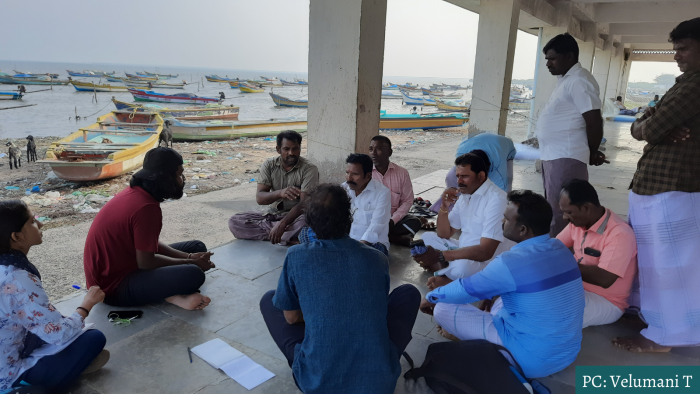
I have had the opportunity to interact with many fascinating people as part of the recently launched Palk Bay initiative in the thematic area of livelihoods. This question posed in the title of this article came from one such person – Palsamy, the President of the Ramanathapuram Fishworker’s Trade Union. Palsamy has spent three decades advocating for the rights and entitlements of small-scale fishers in Ramanathapuram in multiple local and national forums. Our team met Palsamy and Mr. Anand, the union’s General Secretary, to understand the present situation of the region’s fisheries. After a two-hour discussion, he posed this question which has intrigued me since then.
This question reflects the proverb “Life is profound in its simplicity,” as it has many facets, much like the city of Ramanathapuram. Ramanathapuram is one of the oldest cities in the nation with references to the region being present in Tamil Sangam literature and epics like the Ramayana. This region’s pearl fisheries are traced to the Sangam period (3rd century BC-AD 3rd century). Because of Madurai’s proximity to the Gulf of Mannar, a location known for its pearl fisheries, historians have mentioned that this area and its pearl trade are related to the Pandya Kingdom. This can be seen from the frequent mention of pearls and chanks in Sangam literature. This alludes to the historical importance of the ocean, with its vast and diverse natural wealth, in supporting the livelihoods of people from present-day Palk Bay. As diverse as its history are the people who live here with multiple identities both caste and class-wise. Curiously enough, Olaikkuda, one of the villages we work in, is just about 2 km from Rameswaram and has a majority-Christian population, which was first a surprise to discover. Mr. K Navaskani, a Member of parliament belonging to the Muslim community, also suggests the district’s religious diversity. Multiple fishing sub-castes follow various religious practices across Palk Bay. There is an equal diversity of fishing practices in this region.
Fisheries are typically seen as a male domain and that women play a significant albeit largely invisible role in activities that take place in post-harvest operations. The gendered division of labour is stark and these differences in work shed light on how gender identity influences the activities carried out by people in fisheries.
Ramanathapuram also accommodates the largest refugee camp for Sri Lankan Tamils in the state, situated in a place called Mandapam Camp which adds a mix of people having different nationalities within the Ramnad landscape. Despite such multiple divisions in their identities, the cohesive factor among all these people is their identity as fishers which has constantly acted to bring about cohesion despite the periodic conflict.
The question of identity raised by Palsamy links to the recent developments in technology and capital-intensive developments within coastal industries (including fisheries) which have created a class divide within fishers, which has created deeper factions within a seemingly unifying category ie ‘fishers’. The one-size-fits-all fisheries and coastal development policies fail to account for the existence or deepening of such social divisions and identities. An example is the recent revoking of the ban on purse seine nets, which has multiple implications for the large proportion of small-scale fishers of this stretch of Palk Bay. The various SSF fishing communities’ ways of life are negatively impacted by policies that deepen income fissures and class divides. In the livelihood thematic area that I work on, these discussions with local experts, and various fisher peoples’ experiences and insights serve as guiding points that educate us on social structures and systems and in framing interventions. In the few months of my conversations and travels, I now see livelihoods as much more than mere economic steps, but as central to community well-being and the sense of inclusiveness with which the Palk Bay has sustained generations of diverse people of Ramanathapuram.