
Women of the waves: A canvas of coastal fishery livelihood
By Bijoylakshmi Bhagawati
As an Assamese, fish holds a special place in our hearts—it’s our love language and a staple in our homes. When I learned I would be placed in Odisha for the fellowship, I was thrilled at the prospect of having easy access to this beloved staple. The paintings I created aim to vividly capture the scenes of women engaged in various activities throughout the chain of making fish available to customers.
During one of my initial village walks, C.H. Pratima, one of the dedicated field staff from Dakshin, took me to the beach to witness first-hand how the women in her village were drying the fish caught that morning. As we sat beside them, she narrated the pivotal role these women play in the fish supply chain. Early in the morning, sometimes before sunrise at 4 am, these women rise and complete their household chores. They then head to the beach as the men return from the sea, their nets brimming with fish.
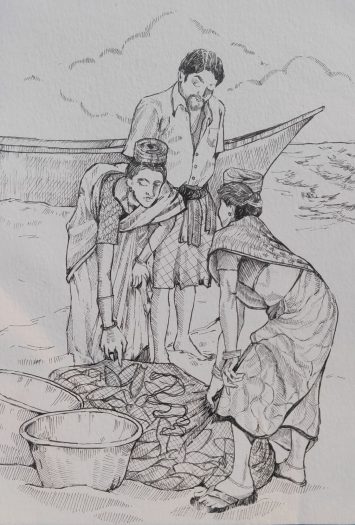
The women take charge, skilfully extracting the fish from the nets and meticulously sorting them based on size, variety, and market price. Laden with loads on their heads, they carry the fish to large barrels where salt and water are added. Clad in simple sarees, barefoot, and often without protective coverings, they spend hours in contact with saltwater and fish. The drying process takes two days or more, depending on the sunlight, whether it be in front of their homes in the narrow lanes or communal open spaces.
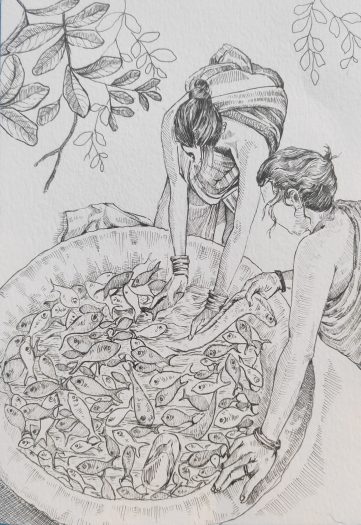
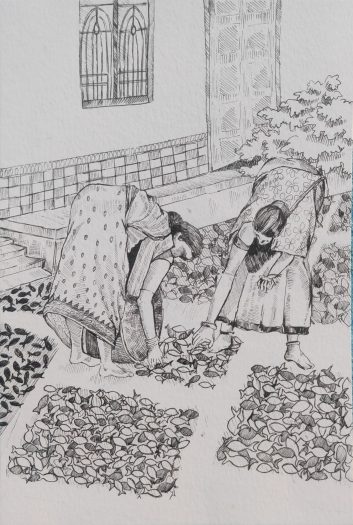
Throughout every step of this labour-intensive process, a collective spirit prevails as groups of women come together, offering mutual support and coordination. They either transport the dried fish to centers like Humma Dry Fish, where local fishermen gather for auctions, or journey from village to village to sell their fish. At day’s end, they share not only the profits and losses but also the collective labour. Returning home as the sun sets around 6 pm, they transition to preparing food and tending to their households.
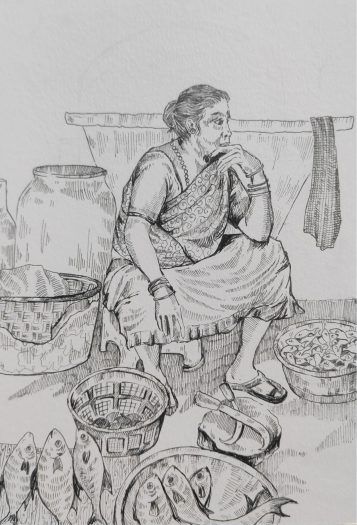
However, in recent years, a sharp decline in fish catch has created challenges in the market. During seasons of fish bans or reduced catches, these women are compelled to migrate to other places to work as construction laborers. Despite the economic significance of the women’s earnings as a major source for household expenses and savings, their financial contributions often do not translate to increased decision-making power within the family. Moreover, this work seldom comes with a retirement age, especially for women who continue to engage in various tasks, such as selling in village markets. They contribute to the chain that brings fish to our tables.
This article was originally published on the blog of the American India Foundation (AIF). Bijoylakshmi is an AIF Banyan Impact Fellow serving with the Dakshin Foundation in Odisha.