
Palk Bay: The ecological paradise
by Athira Prakash
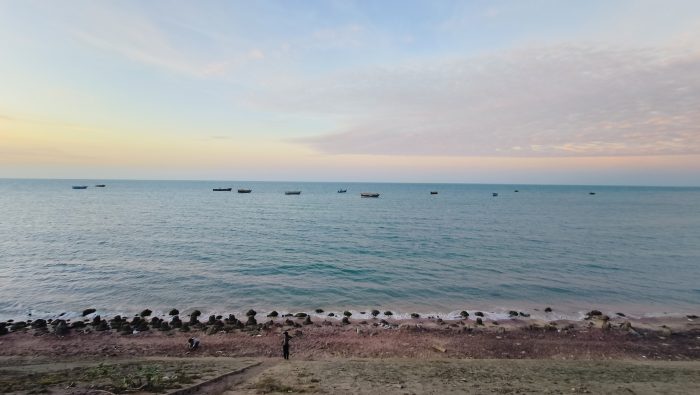
The beautiful Bay of Bengal inlet known as Palk Bay ends to the south at the Pamban Island in Ramnad District, and its northern boundary is marked by the Point Calimere Sanctuary. Palk Bay is somewhat less well known than the adjacent Gulf of Mannar, but is nonetheless recognised for its ecologically sensitive coastal marine biodiversity and unique geomorphology comprising shallow seas and extensive seagrass beds, coral reefs, and associated marine species. Dakshin’s Palk Bay team is thrilled to have access to this amazing space and has a comfortable field base on Pamban island at the foot of the Pamban Bridge. Pamban, a fishing village, lends its name to the whole island, though many also know this space as the Rameswaram Island.
With its team of six, Dakshin is extending its work to the district of Ramnanathapuram, focusing on specific thematic areas such as waste, livelihoods, and conservation of coastal commons. We do this through building local capacities, especially through our Coastal Grassroots Fellowship and with our participatory processes. We have begun work in the Palk Bay with a focus on 4 major fishing villages. Within these thematic areas, we are attempting to build a platform for local initiatives in the Palk Bay with the intention of raising awareness and building capacity to address marine plastics-based pollution, upgrading skills for environmental conservation, including waste management and supporting local leadership development, especially for women from fishing communities.
We are also engaging with the District Collector’s office as a part of the ‘Planning and convergence unit’ which comprises the majority of government departments and non-governmental organisations (NGOs) working to improve the lives of fishermen, protect the environment, and manage natural resources in coastal areas.
My idea of working with government officials from my previous job was more target oriented but surprisingly here, the government machinery itself is focusing more on creative ideas and new initiatives. Hence being a part of this Unit gives me a space to think and open new doors to my creativity rather than following a pre-decided path. We are assisting this unit with its research towards setting up a ‘Neithal Convergence unit’ (NCU) which is focusing on the sustainable development of coastal villages in the district.
Before being a part of Dakshin I was working for the livelihoods of women and Self Help Groups. But from my travels to various fishing villages, and by interacting with incredibly kind people across this district I am learning to see things from different perspectives. I have gained invaluable insights on what livelihoods mean in coastal areas and how different they are from my earlier areas of work.
It’s interesting to observe that there are still numerous traditional fishing practices used along with bottom trawling, gillnets, rod fishing, trapping and many more. The main activities that excited me were seaweed cultivation, blue crab fishing, squid catching, and shell-based octopus fishery. From these field visits, I could feel the effort and difficulties that each fisher faces on a daily basis. Palk Bay has amazed me with new things and experiences in the short time I’ve worked here, and I keenly await the many more exciting journeys ahead.